
"Be a Good Comms Person, But Be a Better Business Person" — How to Unlock Strategic Value as a Communicator with Amy MacLeod
Listen to the episode on Spotify and Apple Podcasts
Listen to the episode on Spotify and Apple Podcasts
This episode is brought to you in collaboration with Invest Ottawa, Ottawa’s lead economic development agency for knowledge-based industries. We teamed up to produce this special podcast series to celebrate women leading in Ottawa during International Women’s Month.
In support of its Women Founders and Owners strategy, Invest Ottawa offers programs and services that enable and accelerate the growth and success of women entrepreneurs from every walk of life.
Visit www.investottawa.ca/women to learn more!
"Be a good comms person, but be a better business person. That is the key to unlocking the strategic value as a comms person. When you can create an environment where people want to know what you think on a topic that's not necessarily related to comms, you have built a relationship of trust and respect." - Amy MacLeod
Amy MacLeod is a senior communications executive with 25 years of experience shaping complex business, financial, and technical developments into strategic communications programs. She believes that good communication comes from connecting people with information that conveys passion and purpose — and that truth, simply told, is the best path to leadership, influence, and corporate credibility.
Amy was named Vice President of Corporate Communications at MDA Space in 2021. Prior to that, she served as VP of Corporate Affairs and External Communications at Seaspan Shipyards and VP of Corporate Communications at Mitel, where in 2018 she was appointed as Mitel's first Corporate Diversity Officer, charged with driving cultural change across the company globally.
Earlier in her career, Amy held progressively senior communications roles at General Dynamics Canada, Alcatel-Lucent, and Newbridge Networks Corporation. She began her career as a political staffer on Parliament Hill, an experience that grounded her in the fundamentals of writing, storytelling, and high-stakes real-time communications.
Amy grew up in a small mining town in Northern Ontario and studied politics at the University of Waterloo. She has been deeply rooted in the Ottawa business and startup ecosystem for nearly four decades, and remains actively engaged as a mentor and advocate for women in leadership.
We Talk About What Matters
You're in communications, or adjacent to it, and you're ready to be treated as a strategic business partner rather than the person they call when they need something written.
You're a founder or early-stage leader who hasn't thought seriously about communications yet, and you'd rather figure that out before a crisis forces your hand.
You want to know how credibility actually gets built with stakeholders, investors, and clients, especially when the news you're delivering isn't good.
You're operating in a high-pressure environment and looking for a more grounded, clear-headed way to show up as a leader.
You're curious about where AI fits inside a communications function and want a perspective from someone who is actively working through that question with her team.
You care about the progress of women in leadership and want to hear from someone who has watched decades of progress wobble, and decided to push harder because of it.
Looking for a specific gem?
[02:36] Welcome and introduction to Amy MacLeod
[05:10] Growing up in a small Northern Ontario mining town and the dinner table conversations that shaped her career in communications
[07:24] The evolution of strategic comms: from Parliament Hill to publicly traded companies
[09:59] Building communications functions from scratch, and debunking what people think comms actually is
[13:44] Why comms is often seen as a support function and how to shift that perception
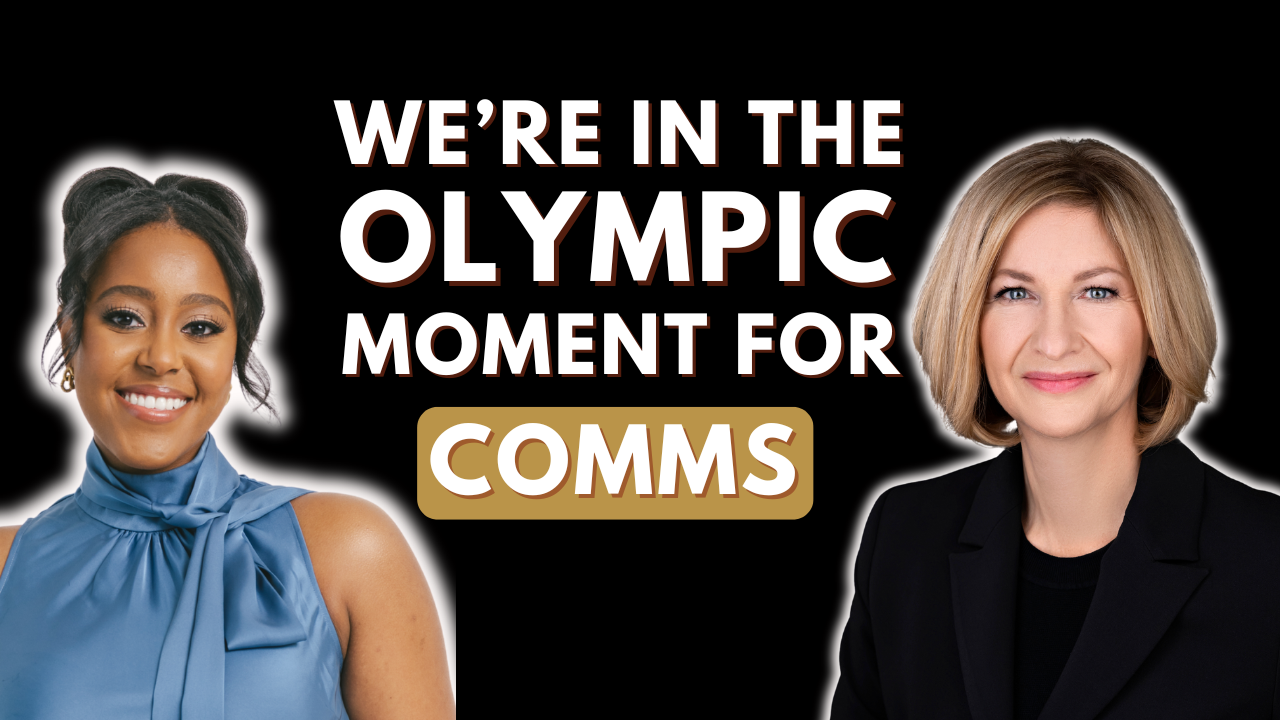
[15:41] The Olympic moment for strategic communications in today's volatile landscape
[17:42] Advice for founders and startups: why seeing comms as a business asset changes everything
[18:53] How to become a trusted advisor, and what it means to weigh in with your opinion, even uninvited
[20:19] Positioning as a core skill: why it's not about pretty words, it's about telling the world how to think about an issue
[23:37] Being consistent in your narrative through mergers, acquisitions, and tough quarters
[27:44] Emotional regulation as an executive, and why your problems are not your colleagues' problems
[29:13] AI in the communications function: how Amy's team is using it, and why she's personally resistant
[32:10] The state of women in leadership, what's disheartening, and what's deeply encouraging
[34:31] Practical ways to pick up the mantle: starting a conversation, running circles, and elevating others
[38:51] Trust your gut and stop shape-shifting to fit jobs that aren't right for you
[41:58] Building a quality life: why career decisions happen in your life, not in a corporate setting
Conversation Transcript
Naomi Haile 02:35
Hi everyone. Welcome to another episode of The Power of Why podcast. My name is Naomi Haile, and today I am here with the incredible Amy MacLeod. Amy, how are you doing today?
Amy MacLeod 02:46
I am good. Nice to be here with you, Naomi.
Naomi Haile 02:49
It's a pleasure. For the last few years, we've been doing this incredible partnership series with Invest Ottawa, and they always deliver with an incredible lineup of female executives and entrepreneurs. I'm very honored to be with you here, Amy.
For the audience, I'll give a little bit of background before we dive in. Amy has 25 years of experience as a senior communications executive and was named VP of Corporate Communications at MDA Space in 2021. She is an expert in shaping complex business, financial, and technical developments into strategic communications programs, and she believes that good communication comes from connecting people with information that conveys passion and purpose — and that truth simply told is the best path to leadership, influence, and personal and corporate credibility.
Prior to joining MDA Space, Amy held a series of executive comms positions in the technology and event sectors, including Vice President of Corporate Affairs and External Communications at Seaspan Shipyards — I actually know someone who works there right now, which is very interesting — and VP of Corporate Communications at Mitel. In 2018 she was appointed as Mitel's first Corporate Diversity Officer with a mandate to drive cultural change for the company globally. Earlier in her career, she worked in progressively senior comms roles at General Dynamics Canada, Alcatel-Lucent, and Newbridge Networks Corporation. She began her career as a political staffer — fun fact — on Parliament Hill.
Thank you so much for being here. You're incredibly involved in the Ottawa business ecosystem, startup ecosystem, and very involved in your community. I'd love for you to share, Amy, where you grew up, whether you were encouraged to color outside of the lines or stay within them, and how that shaped the very high-stakes environments that you find yourself in today.
Amy MacLeod 04:47
Well, thanks for the kind introduction and the opportunity, Naomi. I do like to think of myself as rooted in the Ottawa business community, and part of the community. I've been here since I graduated university, which is hard to believe, but it's coming up on four decades. It is a community. I don't think that many think of Ottawa as something other than government, but I am very proud to be from Ottawa at this point.
But I grew up in Northern Ontario, in a small mining town — big family, six siblings including me — in a hard rock mining town, a long way from Ottawa, with a very traditional family. My mother was a stay-at-home mother. I will tell you honestly, I like to think that I've worked hard in my career, but I don't come anywhere near to the effort that she put into raising us.
Did I color outside the lines? It was a bit of a traditional upbringing, if I'm really honest. But a very intellectually inclined family, very Italian-Scottish heritage, very loud, a lot of fast talkers. So I guess maybe that was a little bit of training for the career I ended up in. We talked a lot about public affairs, politics, world events at our dinner table, and I do think that shaped the direction I ultimately took.
In small mining towns, you either go into mining or you leave. I left and went to the University of Waterloo, studied politics — because that's what I heard at my table — and I loved it. I came to Ottawa, partly because Toronto was too big for a small Northern Ontario girl, and partly because Ottawa is the seat of government and politics. I ended up working in politics early in my career, and I've been in Ottawa ever since.
So it was a little bit of a strange path. A traditional upbringing, but in an environment where we really did talk about world events, big issues, big politics, big changes. When I think about the complex nature of comms in a publicly traded company or any large multinational, there's a lot of relevance in those early conversations about big politics and big changes in the world.
Naomi Haile 06:58
Absolutely. I love that you drew that parallel. You've been in this space for decades and have seen the evolution of comms and the true strategic function that it is — it touches every part of the organization. When you were first starting out, what were some of the most meaningful work experiences that really let you dig in and sit in the nuance of your work?
Amy MacLeod 07:24
I cut my teeth in comms on Parliament Hill, which is just a couple of blocks from where I'm seated right now. That was a different era of comms. Internet was not a thing. It was a very traditional media landscape. Understanding that environment was a comms experience grounded in writing and storytelling — pretty basic — and then getting that writing and story out into the world in real time against very high-pressure, big-stakes situations.
When you're working in national politics, as anybody in this town will tell you, what you do from nine to five is often on the six o'clock news. That helped shape a lot of the foundations of comms for me — how to position national developments, legislative developments, into things that people could relate to.
I believe this still today: when you tell people the simple facts and simple truth, you are actually communicating at the highest level. It seems so basic, but it's hard to do, and we lose sight of it when we're trying to be bigger than we are, or to tell something grander than it needs to be.
There was a lot of early learning in that cut and thrust of Parliament Hill that ended up on the evening news. The issue is different the next day. A lot of muscle was built in those early days.
Naomi Haile 09:14
And for you, there were a few places where you were the one building the communications function from the ground up — it didn't exist. What were those experiences like? How did you go in and build relationships? How did you articulate the value of what you were building? What does setting the foundation look like for an organization?
Amy MacLeod 09:42
It's funny, because that's happened to me in a couple of career journeys. You arrive into a business and there's a perception of what communications is, which is very different from what I think it is and the value it can add. A lot of that early work is debunking what people think it is. I need a memo — let's call Amy and team. I need a press release — I'll call Amy and team. There's sometimes a very narrow perception of what strategic communications is, and the fact that it is strategic is sometimes absent in some contexts.
Those are the fun journeys, too. I remember arriving at General Dynamics Canada — a company I'm very proud of here in Canada — and they had never had a comms director. They didn't have a comms function at all. It was born out of crisis, which is sometimes how these things get catalyzed: there's a problem, we need somebody to handle the problem, we're not doing this very well.
I got into the defense sector having never been in it before. I was blissfully unaware at the time of the complexity of the defense landscape in Canada and globally — what it takes to provide resources to forces, Canadian or otherwise, in this very sophisticated industrial landscape. I came in with a preconceived notion that it would work the same as the tech sector. I had a lot to learn about adapting comms to the industry you're in and to the audience you're working with.
That was a great journey. It was both a professional eye-opening experience, but more importantly to me as a Canadian — and back to that kid from the north who liked to think they were informed and engaged as a citizen — it shaped my thoughts on the role of Canada and Canada's armed forces in the world.
But I also had to shape a lot of opinion inside that organization about what comms is and what it can do. How it can shape thought — which I think, at the end of the day, is the goal of communicators. We shape thought. How to look at an issue, how to think about an issue, how to articulate an opportunity, how to debunk some complex stuff, how to speak simply. That was a real training ground for me.
I very happily left that company with a department that is still functioning. Building that foundation is, at the end of the day, about building trust with the leadership and management team and adding value — which is what we do in comms naturally, but we need to call it out more than we do, because I think it's a subtle thing.
Naomi Haile 12:39
So many good things there. The strategic aspect you've described — really shaping thought in this time, in this environment — there's so much to say here. When you were first starting, you mentioned debunking myths for people internal to the organization. At that time, was comms seen as a support function? Can you talk to us a little bit about that evolution — to where we are today, in such a complex environment, politically and geopolitically — and how you define the necessary work of strategic comms?
Amy MacLeod 13:44
I do think it was — and in some cases still is — seen as a support function. It's transactional: I need something, I'll ask Amy to write me something. Versus a strategic business partner, which is where I think you end up when you're doing strategic comms in a business that understands how to utilize it for strategy and advancement. That's the high bar. That's where you really can add the value that's available from people who know how to communicate.
It is a process to get that shared perspective inside companies. Sometimes they're already there, and sometimes you need to bring them along. It depends on the heritage of the company.
But then you get into the landscape we're in today, where every single day you wake up thinking you know what you're going to do, and then some unexpected inbound will divert you and sometimes the entire conversation for the company. The landscape right now is actually, I think, more fully utilizing strategic comms than any time in my career.
It has been fascinating to have a role to play in shaping the events of the day in a climate where every day the events are enormous. If I can park my anxiety about it as a citizen and all of the change that it means to me, Amy MacLeod, and my family — it is a fascinating exercise in how comms can address and advance a topic, or mitigate issues and damage to a company, a team, whatever it might be. We're in the Olympics right now. It's the Olympic moment for communications.
Naomi Haile 15:46
Absolutely. What you've mentioned about managing reputational risk is so understated. Speaking to the startup community — and I know right now you're working with a publicly traded company — does your advice change for a startup versus a solopreneur or a publicly traded CEO? What are some of the very early structural moves an organization must make to avoid that reputational risk?
Amy MacLeod 16:25
In a small startup, you're just trying to bring some revenue in, keep the lights on, build scale as you go. Functions like comms are not the top priority. But it's important to understand the strategic nature of it even then. You might be a one-person shop doing marketing, internal, external, PR, website, and social all at once — which is often the case.
The single most important piece of advice I have is: see it as strategic. Don't see it as a support function, because when you see comms as strategic, you start to see it as a business asset versus a cost. That doesn't mean you need a huge team or specialists in every discipline. It means you need to see communications as an asset that can accelerate your business.
One resource — yes, that's probably where we all start. But one resource that's at the table, that you treat as a business partner. If there's one thing I've told my team and the people I've worked with over the years, it's this: be a good comms person, but be a better business person. That is the key to unlocking the strategic value as a comms person. Understand the business, understand the dynamics, the risks, where the money comes from, the client side, the markets. Be a good student of business as a communicator, and you will naturally add strategic value — even if you're a one-person shop in a startup that's trying to grow.
Naomi Haile 18:24
That translates to almost every function. When I moved to the states and pursued graduate school in strategic HR, that was the number one piece of advice — yes, you need to be strong in this area, but you also need to understand deeply how the business works in order to be taken seriously. HR was perceived as a support function in the same way, and then during COVID, that all shifted in such a big way. Being that trusted advisor — I'd love for you to go deeper and share how you really earned that level of trust. For people who are maybe in the early or mid stages of their career, it's about accuracy, discernment, business literacy. Can you talk about how people can really step into that trusted advisor role?
Amy MacLeod 19:21
It goes back to the core principle I think underlies the value of communications. You need to weigh in with your opinion — Amy MacLeod's opinion on a topic, sometimes uninvited, sometimes unwanted. I think that's been the catalyst in my career to advancement, to growth personally and professionally, and to adding value to the businesses I've been in.
When you can create an environment where people want to know what you think on a topic that's not necessarily related to comms, you have built a relationship of trust and respect. It requires discretion. It requires diplomacy, professionalism, and all of those characteristics we hope people in leadership positions have. But most especially, it requires the courage and the confidence to share your opinion — to sit at that table and offer your thoughts on how to see an issue, your reading of the issue, options to address it or advance a topic or address a market opportunity.
That is the most fascinating and rewarding part of my experience: getting at that table and just offering my business perspective. Then we can talk about what that means through the comms lens.
It's hard because it requires you to show up. It wasn't something I would have done easily early in my career. But I think it has been the difference in my career journey. The other side of that point is: sometimes the environment will not allow you to do that. If you are not invited to the table, if you are not welcome to share your perspective, that's telling you something you need to know. That's important feedback about the fit you have in that organization.
Naomi Haile 21:14
It reminds me — when you were talking about your origin story and the conversations you had at the dinner table — it seemed like from an early age, you got to flex that muscle of sharing your opinion. And I love what you said about creating an environment where people look to you to see what your take is. That relates to being well-read, being a critical thinker, seeing beneath the surface.
Amy MacLeod 21:49
What we do as comms people is we see beneath the surface. We see around the corners too — we can anticipate where an issue today will take you tomorrow. Bringing that full perspective is important to any business in growth stories, in challenge, in transitions, in big acquisitions.
One of the key competencies for comms people is really to be able to position an issue — to tell the world how it should think about it. It's not necessarily the pretty words that you write. It's: this is what this is, and why it matters. Back to the why of it.
If we could get some curriculum to teach people how to position things, that is a skill that is absolutely essential. And in order to position an issue, you need to understand the business — it's back to being a solid business leader and an exceptional comms leader.
Naomi Haile 23:06
We mentioned earlier being in a publicly traded environment, where you have a lot of eyes and investors always watching. You've led messaging through mergers and acquisitions, financial reporting cycles — people are really looking at every signal a company makes. What can founders learn about being consistent in their narrative, even during tough times, even in the early stages when you're just trying to get revenue through the door?
Amy MacLeod 23:56
Just that — be consistent with the information you share, and be transparent to the extent that you can. Of course, there are regulatory frameworks and requirements in every business, public or not, that must be respected. But honesty and transparency build credibility. That is the equation. I believe it in my bones: credibility comes from honesty and transparency.
Those are the easiest things to do. Tell the truth. Start with the truth, and you build credibility. Sometimes the truth is hard — sometimes the truth is we missed a quarter, or it didn't work out the way we wanted it to, or we've got to do something we'd rather not. But that is where the credibility comes from.
The easy news, the good news — that's easy to communicate. But again, you just tell the truth. You had a great quarter, there was an exciting milestone of some kind. Those things naturally fall. It's just rooting everything you do in the truth. It's so basic I almost feel like I shouldn't have a career if that's my advice. But that is what builds credibility and trust in every single landscape I've been in, regardless of the stakeholder. At the end of the day, it's about relationships, and trust and credibility are rooted in telling the truth. Start with the truth at all times in messaging. I'm going to get that on a t-shirt one day.
Naomi Haile 25:47
The other thing I thought about was the power of being emotionally regulated in this work. Distractions are everywhere, and just being able to not be swayed internally as a leader — having protected thinking time. How do you teach emotional regulation in this profession? How do you practice it as an executive?
Amy MacLeod 26:16
It's such an important topic, because many people are in very high-pressure situations, and nobody knows in the course of a day what somebody else has got on their plate or in their inbox. And then you're expected to always be neutral.
Self-awareness is really important — understanding how you show up as a leader. Whatever is going on in your world, if I'm having a bad day, that's really not Naomi's problem. That's my problem. If I can't manage that emotion, then maybe step away from whatever that conversation is. I don't think we talk about the impact of unmanaged emotions in a corporate setting enough.
I try. I'm not the best at this either, to be really honest — my Italian-Scottish heritage means I am highly emotional on a lot of topics. But I try to always be professional, always be polite and respectful of other opinions and the people in the conversation. Treat others with respect and patience. If you feel like you can't do that, step back from it. Don't go into a situation with your head on fire. It's not going to be productive for you or for whoever you're speaking with.
I had a great coach somewhere along the line who really encouraged me to understand that the person I'm speaking with as an executive doesn't know everything I'm carrying — the deadlines, the four things due in the next 20 minutes. They don't know that. Reminding yourself of that: your problems are not theirs. You're there to lead, not to share your burdens.
There's something really important in your question around emotional regulation in the workplace.
Naomi Haile 28:17
I'm curious now — because we mentioned being in a volatile media landscape, being in a highly regulated industry, defense, aerospace, and now with Earth and Space Observation. There's also the layer of artificial intelligence. I think comms has been a very interesting early case study for AI, just around the language piece and what you mentioned around framing and positioning topics. How do you look at integrating AI right now? What do the conversations look like on your team, and how are you thinking about where it belongs in your workflow and where it ought not to be?
Amy MacLeod 29:13
We're in a regulated industry, so we're careful with our introduction of AI. We are using it. We have a platform called Chat MDA — a closed AI system, not a public one. It's a really fascinating topic on our team, because I'll happily admit I'm the oldest person on the team. I've got young, whip-smart people in their twenties for whom this is really exciting and natural, and they use it daily to help support content development. I think that's going to change the comms function radically, if it hasn't already.
We met recently with the company that does our wire distribution for press releases, and they've introduced an AI capability where you can upload your release and it will instantly tell you how it's going to be received based on the words in it — compare and measure it instantly. That is fascinating research. It's a great first starter for content, and a great research tool because you can tune your content.
I am resistant to use it myself. I know I have to. But I'm from a generation that loved the craft of writing and creating a story or a piece of content that shaped thought, and I'm resistant to give that up. I feel like cursive has already gone away — I get that — and I feel like writing is next. But I actually love writing. It's important to me. I don't want to lose that muscle. I like the exercise and the intellectual challenge of finding exactly the right word.
But the team I'm with is all over it, and they are teaching me how to use it and where it can fit. I find it really fascinating. I'm not sure I'll ever use it myself to write something, because it feels like cheating. But I do think it's going to change the landscape for comms — and probably every other function, if it hasn't already.
Naomi Haile 31:17
Definitely every other function, but I think comms specifically as an entryway because of what it's been trained on. It's very early and easy case studies to build up in this space. I'm glad you have a controlled AI use function as part of how you think about content development. I'm also curious — because something I know is really important to you is the progress of women in corporate and in general. It is International Women's Month, and I'd love to get a sense of what you're hopeful for when it comes to the future of female leadership and entrepreneurship — and how you've been thinking about what's happening in the world and what your support and mentorship looks like for female founders.
Amy MacLeod 33:13
Maybe I'll start with how I'm feeling about where we are in the world. It's been a difficult couple of years — watching decades of progress unravel in a spectacular fashion. It's disheartening, it's concerning, and it's also motivating me to pick up the mantle a little bit more than perhaps I have. I am losing patience with what I'm seeing around the world. I'm far less polite about it, and far more concerned about what I'm seeing with respect to women — women's role in society, women's rights in general, the role of women in business. It feels like we've hit a wall, and we're rolling back. That's very distressing.
What I'm excited about — and I am excited — I'll use my incredible team as an example. These are women who show up expecting to be treated a certain way and to have every opportunity. They don't show up thinking they have to prove more than anybody else. That is so different from when I entered the workforce, where it wasn't really a level playing field and there was this expectation that you've got to prove yourself.
They have no time for that. They are so much more self-aware of who they are, what they deserve, and what they want. They are clear on that. I have such great confidence from the young women I work with who are just driving change and owning their lives and carving out careers that fit their lives and what they want. That's so encouraging, because I know that's the generation that's going to get us back on track. Every time I meet with a group of young women, I am inspired. They teach me far more than I teach them — about the way we should be showing up and where we should be taking things. I am encouraged. It is disheartening to watch what feels like a retraction, but it's also motivating me.
Naomi Haile 34:31
You mentioned that responsibility and picking up the mantle. I feel like just knowing you from this very short conversation, that support would have already been there. What can other individuals who've been in the game for a long time really impart on the next generation — structurally and practically, in a corporate setting or for people starting their own businesses?
Amy MacLeod 35:10
I think it starts with a conversation, honestly, in your own world — whatever that is. Corporate setting, networking setting, a group of friends getting together. Start the conversation. Be the one who says, hey, let's get together and talk about this. I'm feeling unsettled. I don't like what I'm seeing. What are you seeing? It doesn't have to be a grand plan. It needs to start with a conversation.
Anybody can start a conversation. Pick up the mic. Call your friends, call your team together, say: this is what I'm seeing — what do you think? Because it's that conversation that unlocks concern and maybe generates ideas around what we should do about it.
I am a big believer in simple conversation as a catalyst to action and change and progress. It doesn't have to be a grand stage. It doesn't have to be more than four or five people. When I was Diversity Officer at Mitel, we ran a program called Lean In Circles — part of the Lean In series. You get people together and talk about a topic. Sometimes it was defined, often it was just a setting to engage on a topic of the day. It was a simple conversation among people who wanted to talk about women and where we are in the world and in the corporate setting. I found that such a good model, because anybody can do that. Low bar — just start a conversation.
Naomi Haile 36:54
You mentioned the pride you have seeing younger women who are coming into workplaces uninhibited, standing in their power. For those who don't necessarily feel that room exists in their settings — how have you seen the effective way to break through that, to own who you are and what you bring to the table, even without 20 years of experience behind you?
Amy MacLeod 37:36
Honestly? I didn't. I kind of retracted from being a woman for the first 20 years of my career. I didn't think it would be an advantage to me. I thought it would be an obstacle. I'm not sure I was wrong. So I didn't lean into anything to stake my claim as a woman — I tried to just show up as a business leader. For better or worse, that was the environment I was in.
Back to why I love this generation: show up and own your space was not something that would have been normal in the early days of my career. But it is now. I think there are a couple of things any of us can do, at any level, at any age, whatever the title. One is: pull others in and elevate them. Acknowledge the people in the room. Naomi, you are killing it. That costs me nothing to elevate somebody who I think is doing incredible work. We can all do that.
The second thing is: trust your gut. I believe the mistakes and regrets in my career were when I didn't listen to my gut — I knew something could happen, but I ignored it. Trust your gut. You may or may not fit in every scenario, and fitting in is not the objective. Finding a place where you fit — that is the objective. I didn't understand that earlier in my career. I wanted a job, and I would shape-shift to get it. That's a learning all these years later: I should not have done that. I should have been who I was.
And finally — the greatest piece of advice I've often received, and I credit my husband, who is my greatest career coach and true partner: try it. If it doesn't fit, try something else. It demystifies these big decisions. It just releases you to say, okay — try it. If it works, great. If it doesn't, try something else. We don't have to make it bigger than it is.
Naomi Haile 39:59
That's the ultimate unlock. And you mentioned — your husband got you the podcast mic you're using right now?
Amy MacLeod 40:11
He did — yesterday, actually.
Naomi Haile 40:14
Having someone right there with you — as a coach, as a supporter, as a listening ear — and that advice around try it, and if it doesn't work, do the next thing — that advice alone can change your life.
Amy MacLeod 40:33
It did, in many instances where I was asking myself: do I want this job? Do I not want this job? It's a big decision. I've got a two-year-old. Can I handle all of that? It really did release me to just say, okay, try it. If it doesn't work, try something else. It's just a job, at the end of the day.
It's really profound. There's something very important in that: the best career coach and network you have is your family — or the people you choose as your family. A network of women, close friends, whatever that looks like. That network outside of the work environment is so important to making the right choices in your career. Career decisions don't happen in a corporate setting. They happen in your life.
Naomi Haile 41:20
This has been a really great conversation, Amy, and I appreciate your candidness and openness to talk about the full spectrum of things we covered today. I wanted to end on this note: given everything you just mentioned about career advancement happening outside of the corporate setting — how do you specifically look at building a quality life that incorporates your work and everything else you have going on? How has that evolved over your career?
Amy MacLeod 41:58
I haven't done it well, I'll be honest. I have worked a lot in my life, and many people have. The tech sector, the defense sector, the corporate setting — these are demanding environments at the best of times. But I loved it, and I really enjoy the intellectual exercise, the professional exercise, the engagement. I've committed a lot of time. I have not always balanced well.
There is this notion of a blended versus a balanced life, and I think that's true. One of the things I've aspired to do — and will admit I fail on most days — is to really build life into your calendar. Structurally put it in. From five to seven in the morning, I'm doing this. From seven to nine at night, I'm doing these other things. I am blocked. Easy to say, hard to implement, but it should be the goal.
The other thing I would say: it goes fast. I'm coming up on four decades of my career, and it goes really, really fast. Everything I spent my Saturdays and Sundays on in the early part of my career — the evenings, the weekends, the holidays — it would have got done. Recognizing that over time, it all has space in your life. But your life can't take a second seat all of the time. It has to be part of the equation.
Naomi Haile 43:41
You've got to fit it in. A perfect way to end the conversation. Thank you, Amy — it was a pleasure to meet you, to learn more about your story, and all of the incredible advice you shared around communication, strategic communications, and positioning. Thank you for being here.
Amy MacLeod 43:58
Thanks for having me.
Naomi Haile 43:59
And thank you everyone for listening to this episode of The Power of Why podcast, in partnership with Invest Ottawa. We will catch you in the next one.
Listen to the episode on Spotify and Apple Podcasts
Connect with Amy
LinkedIn: Amy MacLeod
Website: MDA Space
LinkedIn: MDA Space
Connect with Naomi
Website: naomihaile.com
LinkedIn: Naomi Haile
Instagram: @naomiahaile
YouTube: Naomi Haile